At a glance
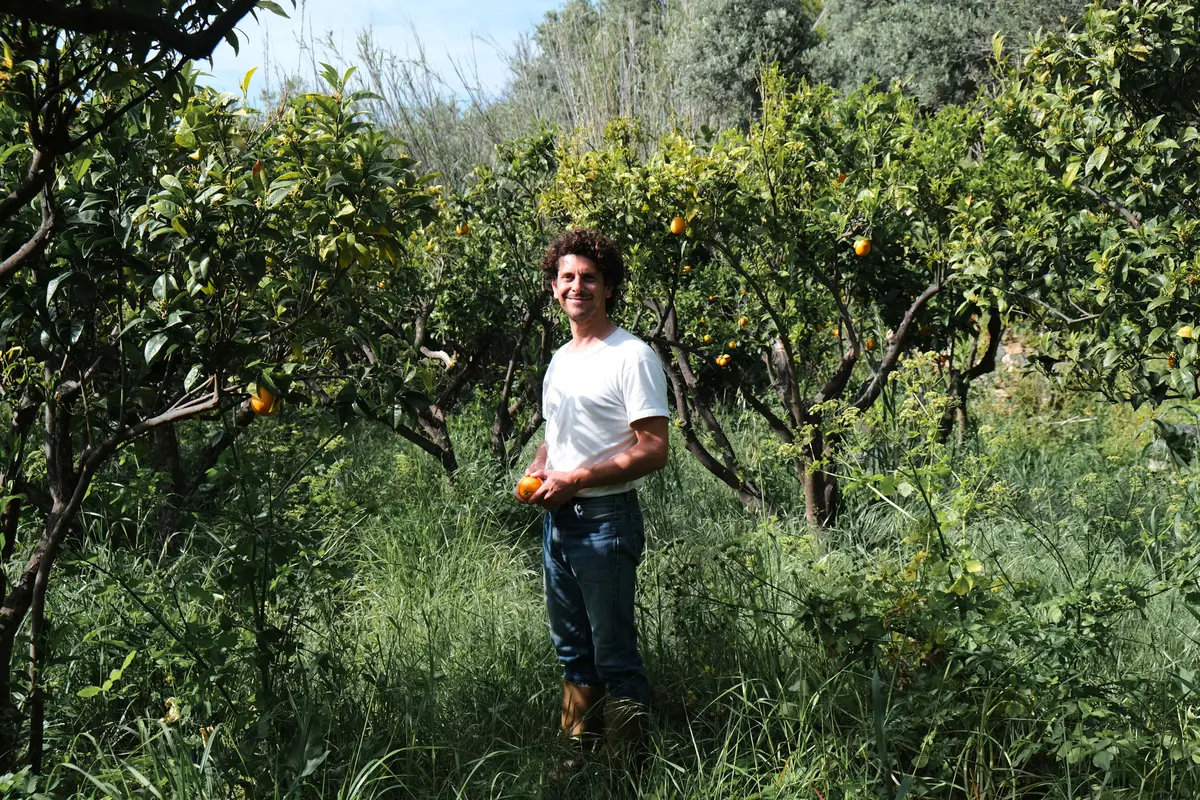
Socrates’ Garden is a citrus orchard in the Melanés valley on the island of Naxos, bought in 2020 after more than five years of neglect. Its founder, Benjamin Cazeaux-Entremont, is turning it into a food forest using the principles of syntropic agriculture: plants layered as they would be in a forest, sheltering, shading and feeding one another. The experiment is documented as a research site, and funded in part by renting out a restored stone shepherd’s house that overlooks the terraces.
Origins
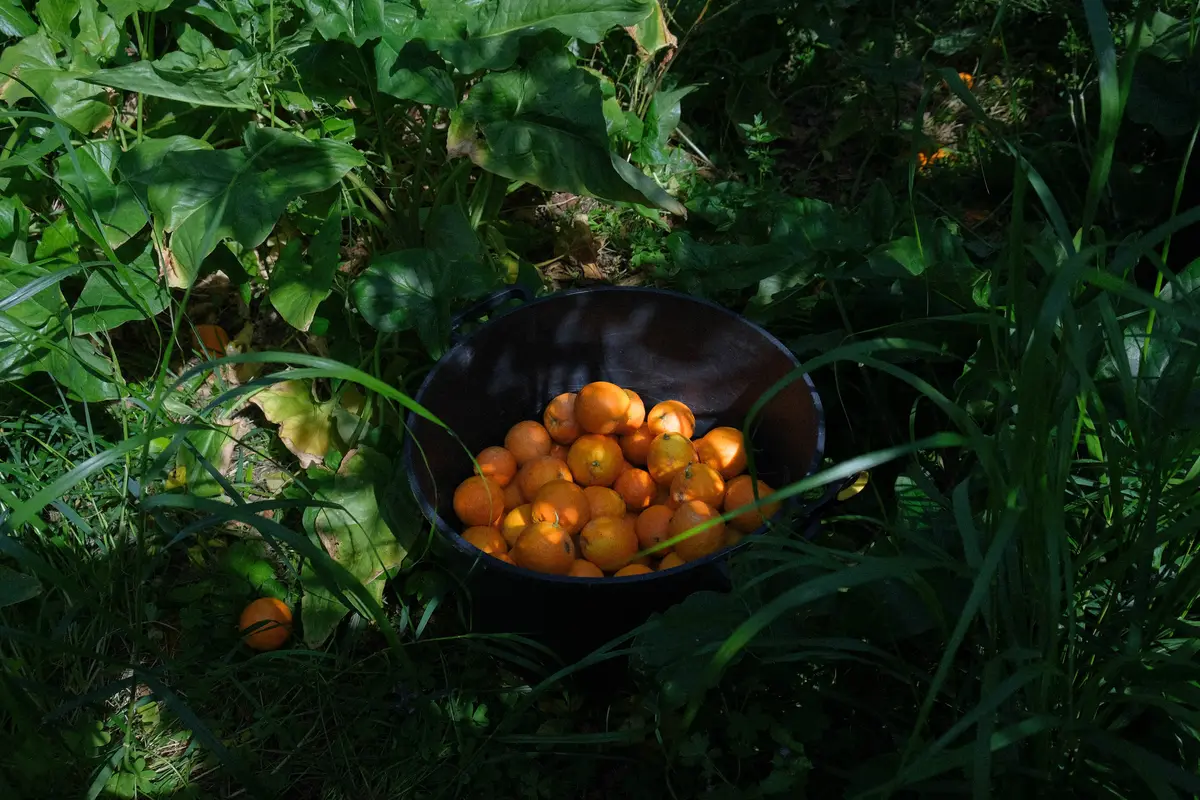
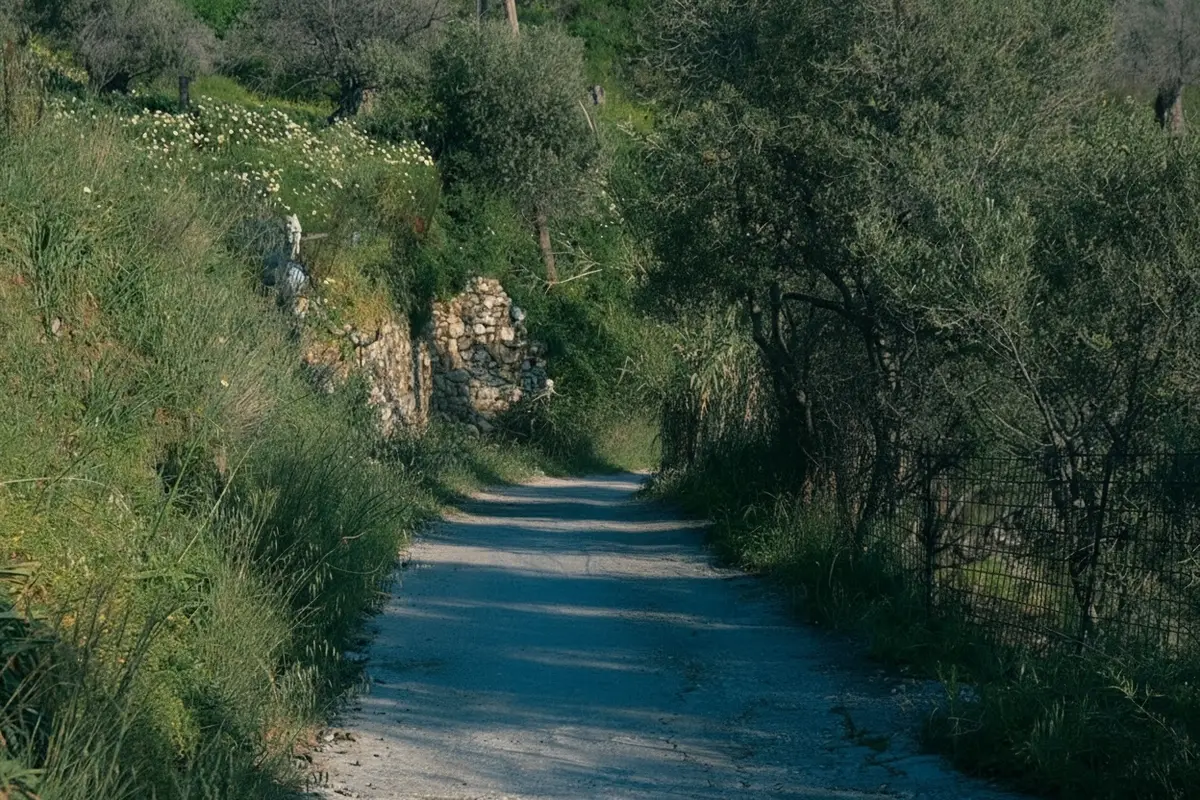
In 2020 the orchard was a place nobody visited any more. Some forty years earlier, orange, mandarin and lemon trees had been planted on five terraces along the old path from the village of Kourounochori to the hamlet of Mili. Without irrigation the trees were dying, and brambles had made the land hard and dangerous to reach.
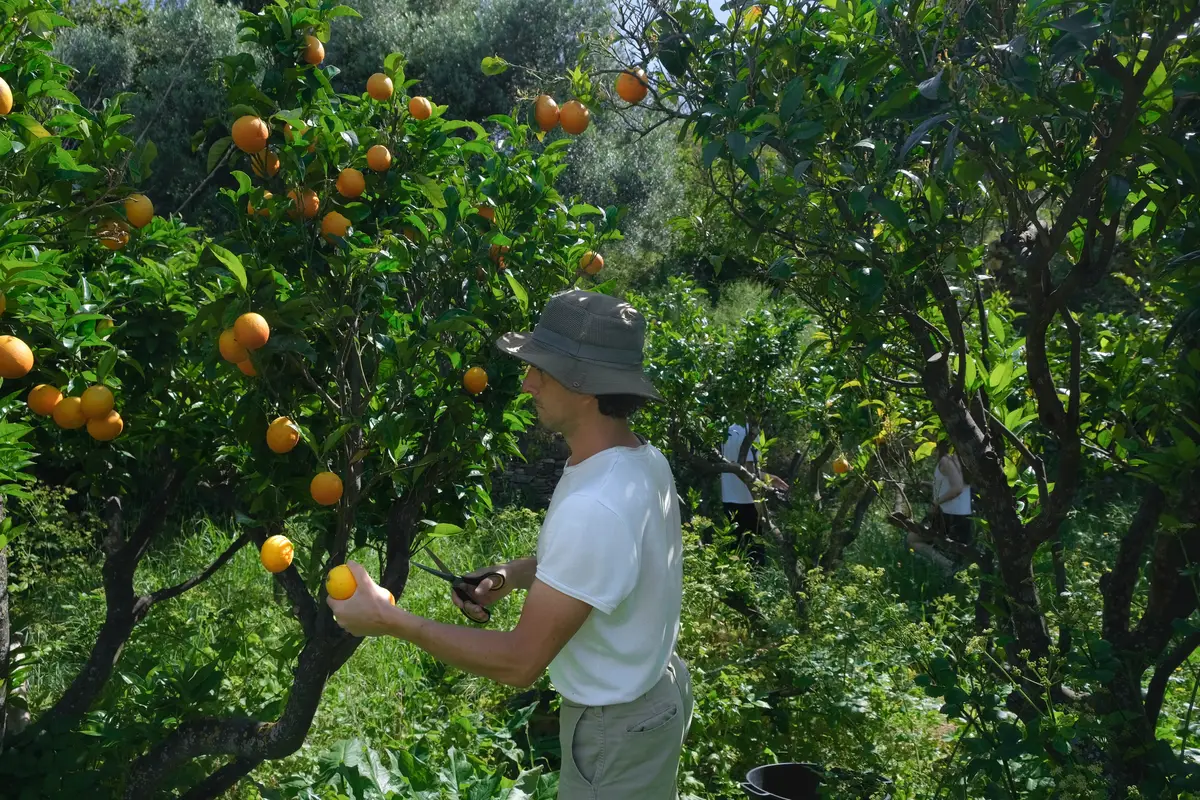
The years that followed were years of manual work. Clearing, bramble removal and citrus pruning in 2021. A 55 m³ reservoir and drip irrigation in 2022. Restoration of the old stone shepherd’s house in 2023, completed in 2025 alongside the pruning of the olive trees. The orchard was saved; what remained was to make it able to stand on its own in a changing climate.
The orchard in figures
- Area: 3,563 m² (surveyed), on five terraces (T1 to T5), 140 to 152 m above sea level.
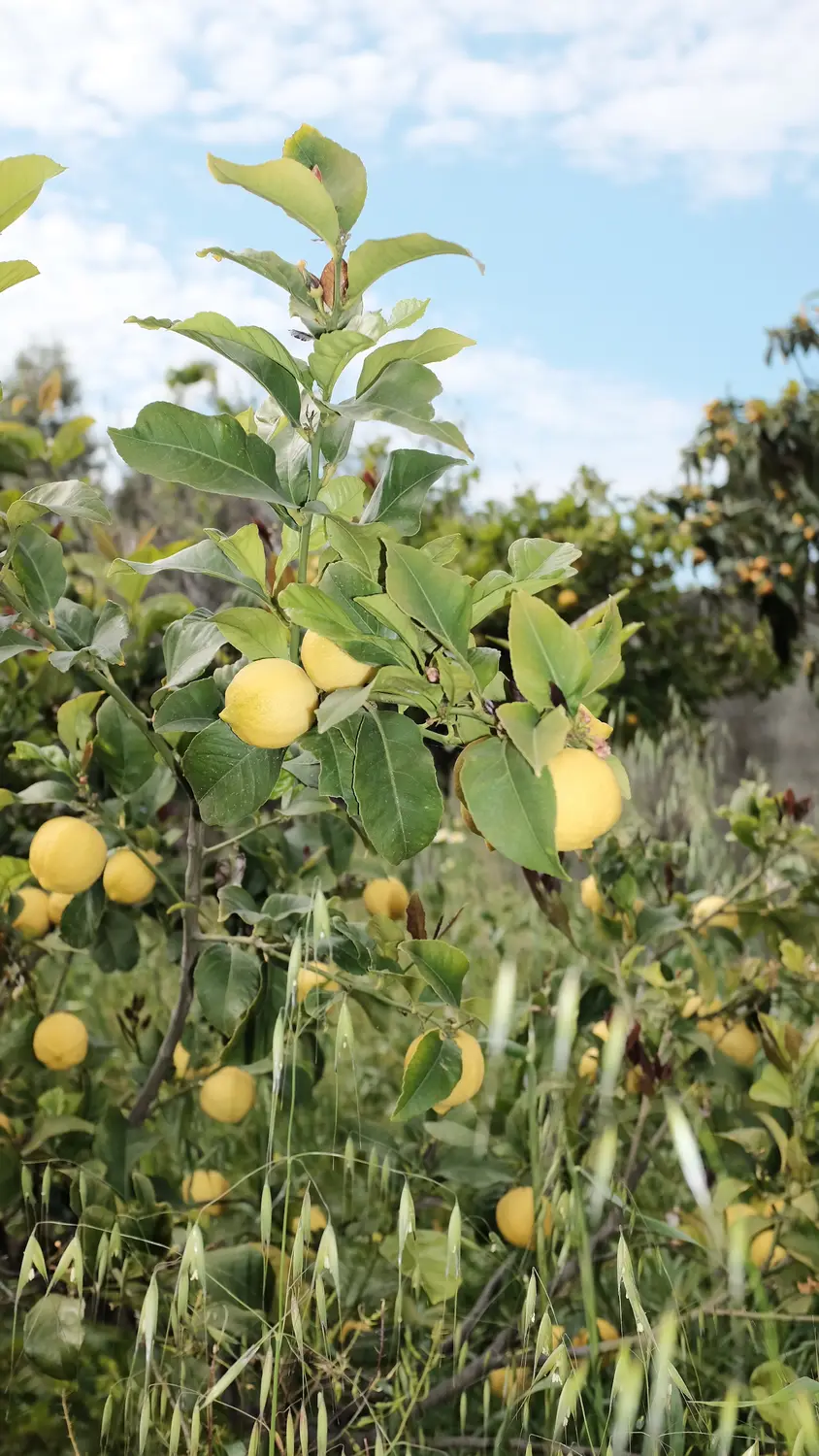
- Heritage trees: 133 individually surveyed trees — 105 citrus (85 orange, 11 mandarin, 9 lemon) and 28 fruit trees (plum, loquat, cherry, mulberry, pomegranate, one apricot, one persimmon) — plus some twenty olive trees.
- 2026 planting: 939 plants of 35 taxa, a density of about 2,600 plants per hectare.
- Planted diversity: about 41 taxa in total.
- Water: 55 m³ reservoir, drip irrigation since 2022, fed by a traditional irrigation canal opened every eight days.
- Setting: thin karst soil, semi-arid island Mediterranean climate, exposed to the meltemi wind.
The context. Annual rainfall in Greece fell by 10 to 25 % between 1951 and 2010. On Naxos, yearly totals have stayed roughly stable, but violent downpours are more frequent and dry spells longer. Island-wide mapping shows erosion risk tipping over: 89 % low-risk land in 1950–1970, around 70 % high-risk land since 1985. This is the climate the orchard has to adapt to.
The syntropic project
Syntropic agriculture, developed in Brazil by Ernst Götsch, starts from a simple observation: nobody waters, fertilises or weeds a forest. It manages through density, layering and the succession of species. The Naxos orchard adapts these principles to a semi-arid setting.
- Stratification: four layers of vegetation, from ground cover to emergent trees, to use all the light and build a microclimate.
- Succession: pioneer species that make room for the next ones, as in a forest growing back.
- Densification: soil that is always covered, loses less water and weeds itself.
- Biomass: regular pruning feeds the soil and closes the fertility loop.
- Cooperation: nitrogen fixers, pollinator plants, living windbreaks — each species serves the others.
The basic unit is a 12-metre module repeated along rows drawn on the contour lines: four heritage citrus trees, two emergent trees, fruit trees and a walnut, eight support species and sixty ground-cover plants. Multi-layer windbreak hedges line the windward edges.
A campaign that found its backers
In late 2025 the project ran a Kickstarter campaign to fund soil preparation, irrigation upgrades, planting rows, windbreaks and a nursery. The goal was €9,300. When it closed on 31 December 2025 it had raised nearly €11,000, about 117 % of the goal, from 46 backers in 9 countries (France, the United States, Greece, Belgium, Switzerland, Sweden, Canada, Georgia, China).
The rewards turn each backer into a character of the orchard: 24 backers earned the right to name a tree after a literary or mythological figure, with a quotation from the work. These names will appear on the orchard’s interactive map, on the website and in the annual book. Two backers chose a week’s stay at the shepherd’s house.
March 2026: the great planting
In March 2026, 939 plants of 35 taxa went into the ground, for a budget of €3,506.
| Layer | Plants | Main species |
|---|---|---|
| Climax and emergent trees | 34 | holm oak, carob, Aleppo and maritime pine, jacaranda, Washingtonia palm |
| Support trees and windbreaks | 70 | white mulberry, nettle tree, black locust, silk tree, ‘Totem’ and spreading cypress |
| Fruit trees (target crops) | 25 | nectarine, jujube, white fig |
| Structural shrubs and hedges | 135 | shrubby germander, Jerusalem sage, perovskia, rockrose, shrubby hare’s-ear, Texas sage |
| Ground covers and aromatics | 675 | thyme, oregano, lavenders, rosemary, sage, savory, santolina, immortelle, lemon verbena, feather grass, wormwood |
The climax layer was planted as designed, the support layer reinforced. The aromatics — thyme, lavender, rosemary, sage, immortelle — are at once ground cover, pollinator plants and the raw material of the orchard’s future products.
The laboratory
A regeneration nobody can check is only a story. From the start, Socrates’ Garden has committed to documenting what the method changes, and to opening that data to other projects.
The orchard is therefore organised as a field site. Two two-week field campaigns a year, in April and October, the first in April 2027: “year zero”, the baseline that can never be taken again. The indicators are few and always measured the same way at the same points:
- Soil: organic matter and pH, soil life (earthworms, spade test), infiltration, decomposition (Tea Bag Index);
- Flora: survey of spontaneous flora, growth of 15 to 20 reference trees;
- Fauna: pollinators (SPIPOLL protocol), birds (BirdNET acoustic recording), arthropods;
- Landscape: fixed photo points.
A highly diverse “laboratory” plot is used to trial new species and validate planting patterns. The orchard is open to master’s students and researchers in agroecology and agroforestry — in Greece and France first, then across Europe — and is reaching out to distributed-experiment networks.
Two residencies
Outside the rental season, the shepherd’s house hosts two two-week residencies, with accommodation provided:
- The field residency, for a student or researcher running a measurement campaign as part of a thesis or research project;
- The writing residency, in partnership with La Chapelle Saint-Antoine, the contemporary art residency co-founded by Benjamin Cazeaux-Entremont. A writer is given two weeks of quiet, facing an orchard that changes before their eyes.
La Bergerie: staying to fund the work
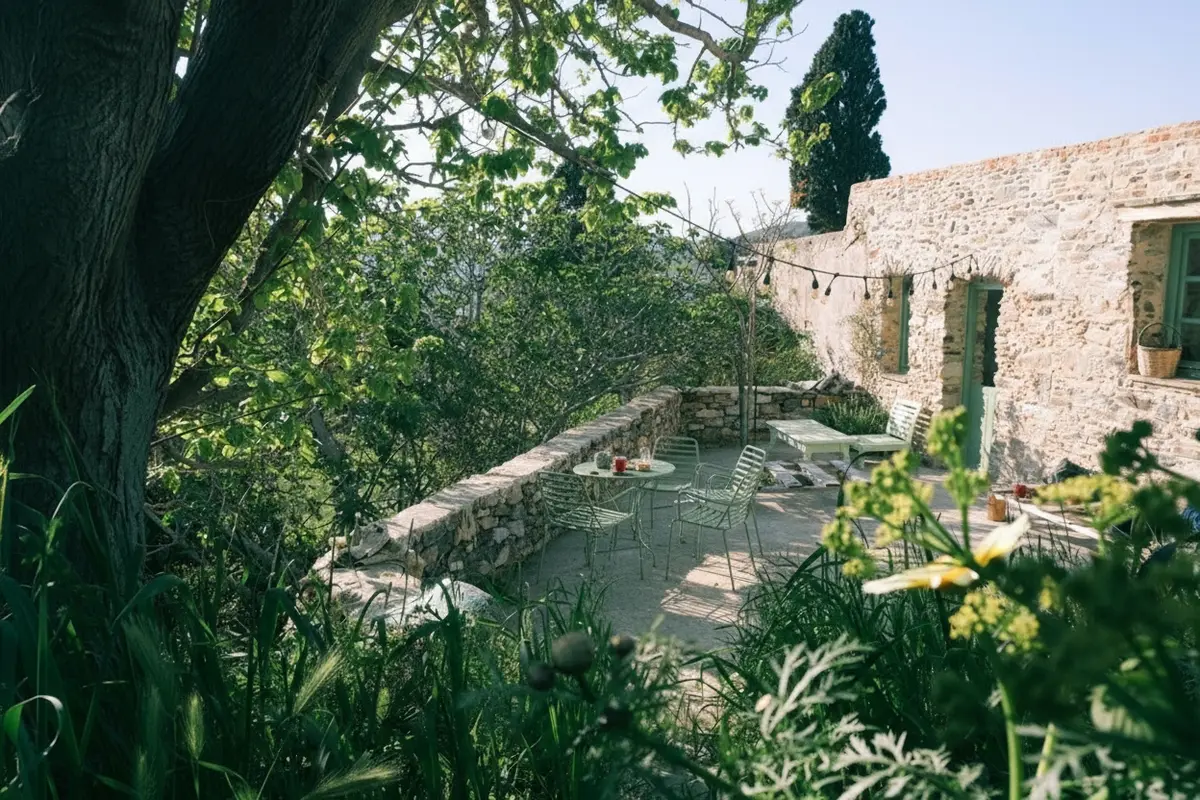
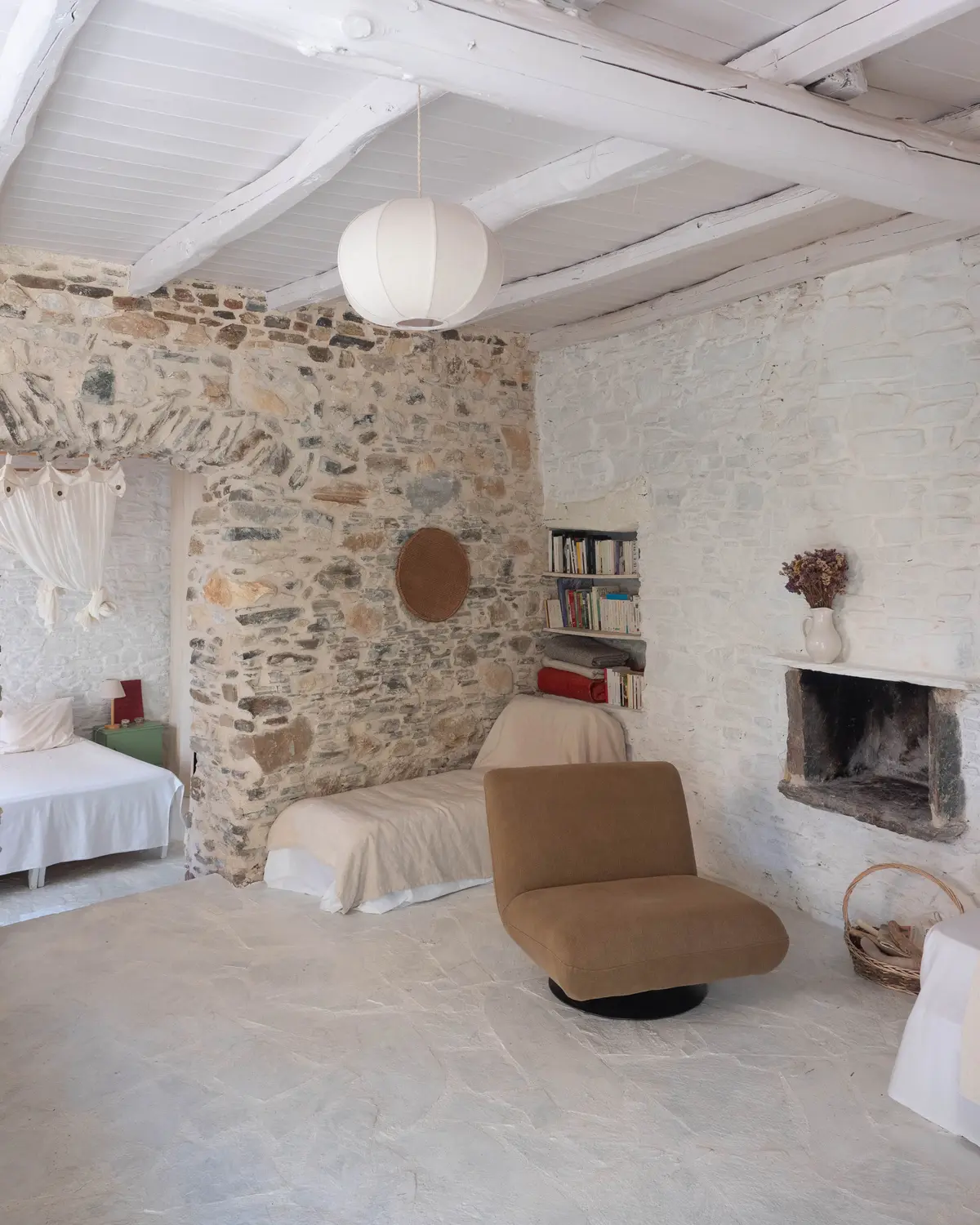
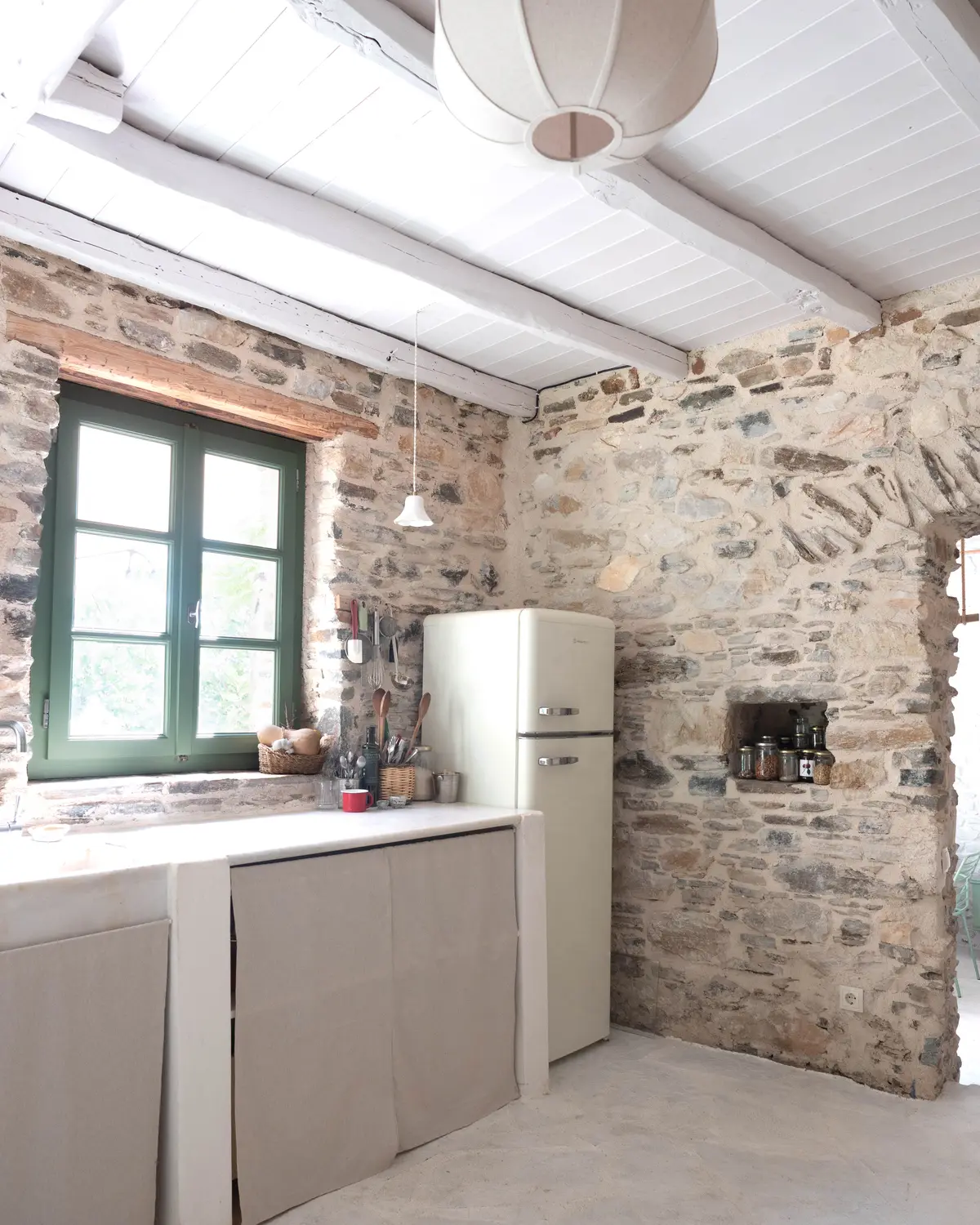
Above the terraces, the old stone shepherd’s house was restored between 2023 and 2025: dry-stone walls, white lime, painted beams, linen and pale wood. 50 m² inside, one bedroom, a kitchen open to the living room, a shower room, and a 40 m² terrace looking over the orchard. It sleeps two adults and a child.
It is rented by the week: €900 per week, €1,200 in July and August, cleaning included. The pool you may notice in the photos is not a swimming pool: it is the orchard’s irrigation reservoir, filled every eight days from the canal.
Renting is not a side line: it is the project’s economic engine. Every booked week pays for the orchard’s work — the planting, the pruning, the water, the patience.
2027: a skincare line
From 2027, the orchard’s fruit and plants become the material of a cosmetics brand: citrus and aromatic hydrosols, balms made with olive oil and honey, powders and preparations from the peels. Short seasonal series, named after the characters chosen by the campaign’s backers.
2028: the kitchen garden
In 2028, once the orchard’s framework has been shaped by the major prunings, the project will start its first market-garden production, integrated into the syntropic rows.
Timeline
| Year | Milestone |
|---|---|
| 2020 | Purchase of the orchard, abandoned for more than five years |
| 2021 | Clearing, pruning of citrus and fruit trees |
| 2022 | 55 m³ reservoir and drip irrigation |
| 2023 | Restoration of the shepherd’s house |
| 2025 | Olive pruning, shepherd’s house completed; Kickstarter campaign |
| March 2026 | Planting of 939 plants of 35 taxa |
| October 2026 | Launch of the website and the orchard’s living map |
| April 2027 | First field campaign — year zero |
| 2027 | Densification, first major pruning; launch of the skincare line |
| 2028 | Structural pruning, planting of target crops; first market-garden production |
The founder
Benjamin Cazeaux-Entremont holds a degree in business law and trained as a documentary filmmaker. A novelist and former editor-in-chief of cultural magazines, he co-founded La Chapelle Saint-Antoine, a contemporary art residency on Naxos. For him, Socrates’ Garden is as much a writing project as a farming one: a place that tells its own story as it changes, recorded each year in a book that is at once logbook, field manual and open knowledge base.
Contact
Benjamin Cazeaux-Entremont — founder
Press: presse@socratesgarden.org
Instagram: @socrates_garden
Web: socratesgarden.org
High-resolution photographs available on request.